
December Newsletter
Commonplace notebook "recipe" * Holiday book recommendation * Winter print gift idea


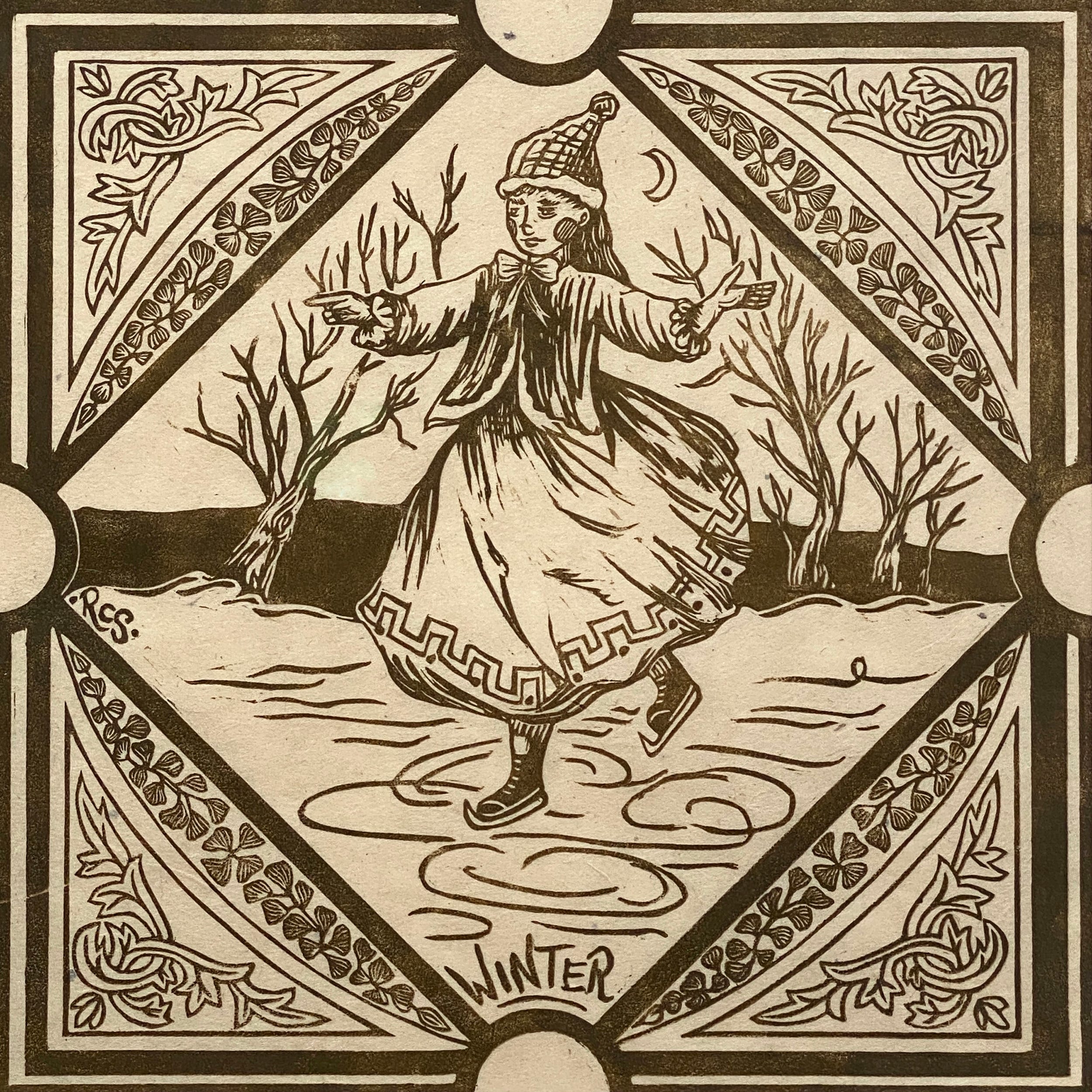
“In Our Present Joy” by Devon-based printmaker Rachel Snowdon (scroll to the end to buy her 2026 foraging calendar)
Dear Reader and Apple Barn friend,
Winter has settled in, and things are quiet here at the Barn. The last chrysanthemums came out of the polytunnel in late October, and the bulbs are (mostly) planted up for spring — though I’ve kept it modest this year, just a few pots. Now comes the season of waiting in the dark, hopefully with firelight for company, or a warm soup, or a book that keeps you close. I’m trying to move more slowly, to let myself soften into the shorter days rather than get swept up in the strange, accelerating pressure to be endlessly productive at precisely the time of year when we should be gentler with ourselves.
A small update from here: we’re hoping to give the studio a glow-up in the new year. I’m daydreaming about cosy touches — perhaps a woodburner, a nook for an art library — and rethinking our letterpress setup. Do we upgrade to a larger platen press, or continue with our beloved little Adana for another season? I’m famously terrible at documenting “before and afters,” but I’m going to try to use this newsletter as encouragement and share the process with you as we go.
Today, though, I wanted to offer something a little different: a book review. I’ve been thinking about how best to use this space, and one of my deepest passions is lifelong learning. I’ve fought hard to keep reading at the centre of my life — through parenthood, moves, and general life chaos — and I know this isn’t easy for everyone. No judgement at all if the habit has slipped. But during these quiet winter months, I thought I might share a bit of what I’m reading. Partly to inspire you to pick up a book this season, and partly, selfishly, to deepen my own practice.
I’ve been teaching myself to keep a commonplace book. Long-time readers will know I’m devoted to morning pages, and now I’ve added a small layer of self-study: underlined quotes, copied out into a notebook, followed by a few lines of reflection. It’s simple — and yes, a little laborious — but I’ve always loved writing out quotes. As a younger reader I kept entire notebooks of aphorisms and fragments of poems. This is just a way of dwelling a little longer with a book, resisting the urge to treat everything as “content,” and reclaiming a bit of agency in how I think.
Commonplace Book: a simple recipe
• Underline a sentence or passage that catches you
• Copy it into your notebook
• Write a few lines about why it struck you or what it revealed
Even ten minutes is enough. The point isn’t to create an archive; it’s to linger.
Craftland — James Fox
The book I’m reading now, Craftland by James Fox, surprised me with how moving it is. One idea that really stayed with me was his description of the soundscape of pre-industrial Britain. He notes that the loudest sound you might have heard was equivalent to today’s lawnmower — which is astonishing when you think of the constant noise that surrounds us now. He writes about this in the context of bell-casting, describing how a single church bell could be heard for miles because the world was otherwise so quiet: the tap of a stonemason’s hammer, the clop of horse hooves, and not much else.
I felt a strange sense of nostalgia reading this — perhaps an auditory nostalgia. Maybe it’s my early musical training, but I long for a quieter world. Not just externally, but internally too. So many of us now live with a kind of constant inner noise — badges pinging, texts buzzing, the news endlessly swirling. And I found myself wondering whether the external quiet of earlier centuries allowed for a different kind of inner quiet… or whether that’s a fantasy cooked up by sentimentality. I’m genuinely not sure.
Another theme that gripped me — and one I’ve been increasingly animated about — is the way so many traditional crafts are becoming endangered or even extinct. Having spent years working in the arts and in climate, I think a lot about loss: of species, of ecosystems, of cultural memory. Fox writes about disappearing crafts with such tenderness, showing how many are held by just one or two practitioners whose personal circumstances — their health, their finances, their time — determine whether that knowledge survives.
One letter cutter he interviews writes beautifully about the responsibility to pass on a craft. That each person is, in a sense, a living repository of knowledge — and without intentional transmission, the knowledge vanishes. Paper-making, stone-walling, letter-cutting, basketry: once lost, they don’t simply reappear. Something about that struck me hard. These practices aren’t inert traditions; they’re kept alive by individuals willing to hold them.
Time is another thread he touches on — the idea that craft requires a different relationship with time. You must be intensely present in the minute-to-minute work of your hands, but also hold in view the long horizon of the craft itself, how it lives on beyond you. It’s a kind of temporal duality entirely at odds with our sped-up world, and reading about it felt oddly grounding.
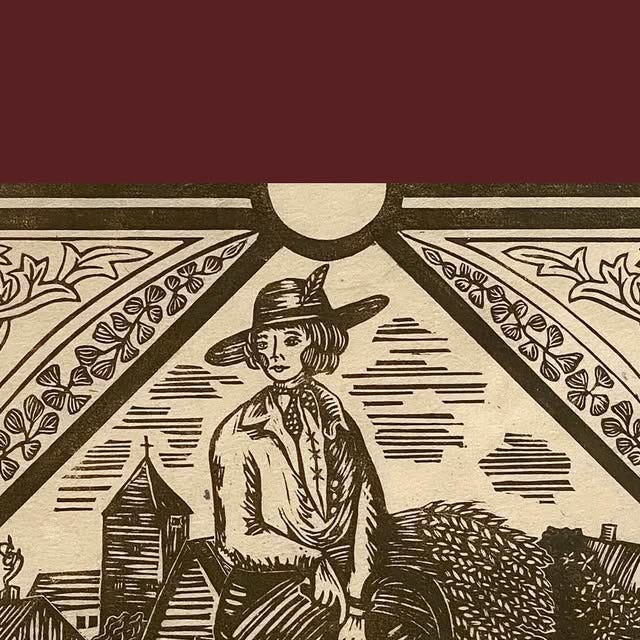
Fox also writes about the diversity of crafts across Britain. I didn’t know, for example, that each region had its own style of basket — and with each basket, a whole associated vocabulary. When a craft disappears, we lose both the knowledge in the hands and the language around it. As Jeanette Winterson writes, “Language is a finding-place not a hiding place.”
One fact that stopped me in my tracks was the reminder of how dramatically Britain has changed in just a few generations: once producing a significant share of the world’s goods, now replaced by global manufacturing shifts. Fox includes a map showing historical industries across Britain, and it brought into sharp relief not just what we’ve lost, but how quickly those changes happened.
Craftland would make a beautiful Christmas present for a reader or a craft lover. It’s unexpectedly uplifting: full of extraordinary stories, gorgeously illustrated, and made with genuine care — from its mustard-yellow cover to the hand-lettered artwork by several illustrators. It’s both a gift book and a book with something serious to say about attention, time, and what we choose to keep alive.
Before I go, I want to let you know how you can buy some of Devon-based printmaker, Rachel Snowdon’s prints. You saw her beautiful, seasonal artwork at the top of this newsletter. If you want to gift it to someone you love — or yourself! — then I can highly recommend her foraging calendar for 2026. It is entirely hand-carved and hand-printed on oat paper, and the top section can be detached and displayed long after 2026 is over.
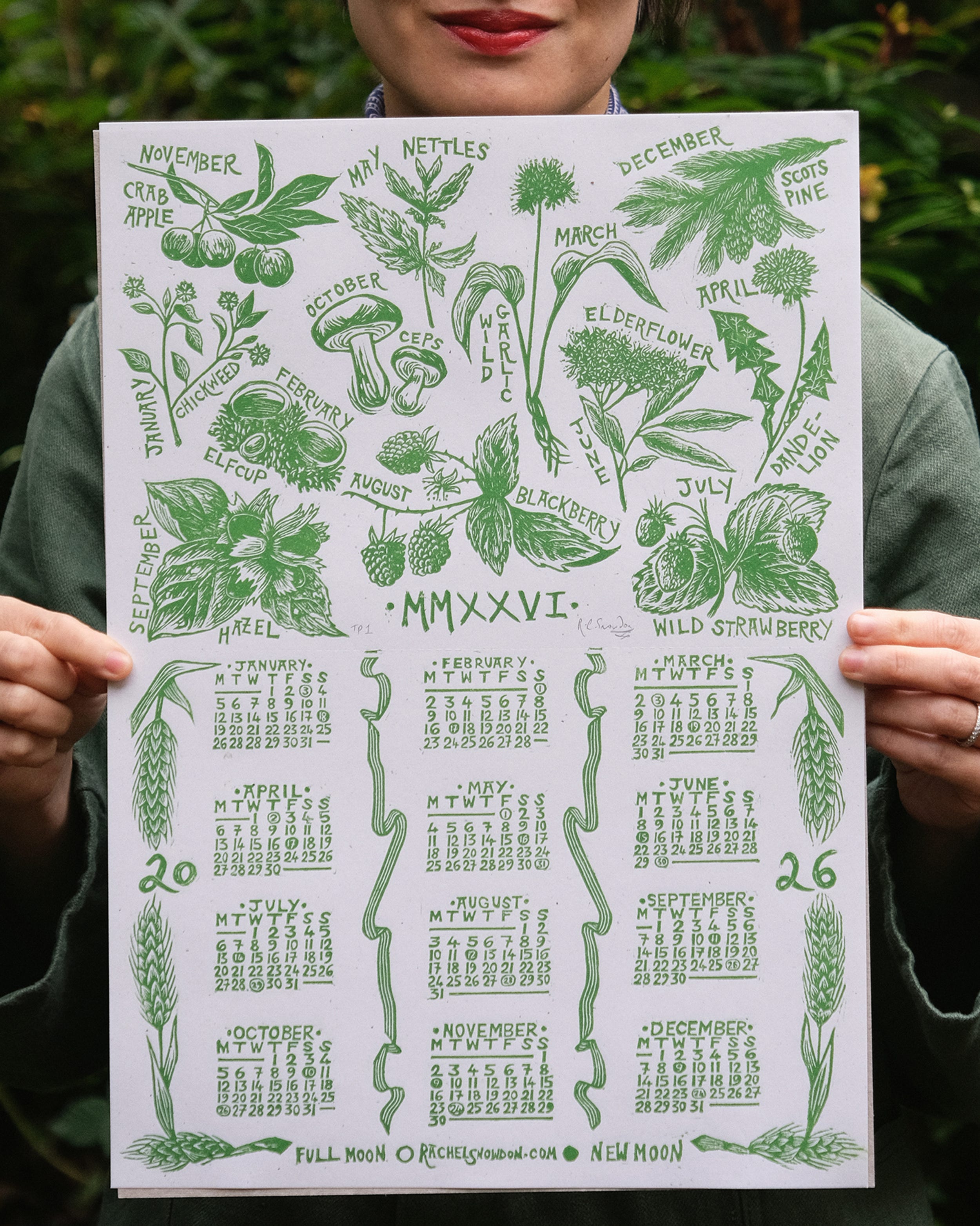
Read more from Rachel on her Substack, Artist’s Proof
I’ll leave it there for now. Wishing you a peaceful week ahead.
Natasha
 | A guest post by
|
Beautiful woodcuts & linocuts too!
Beautiful piece about wintering. I never knew about the different styles of baskets either. Thank you for sharing.